Canfield Solitaire
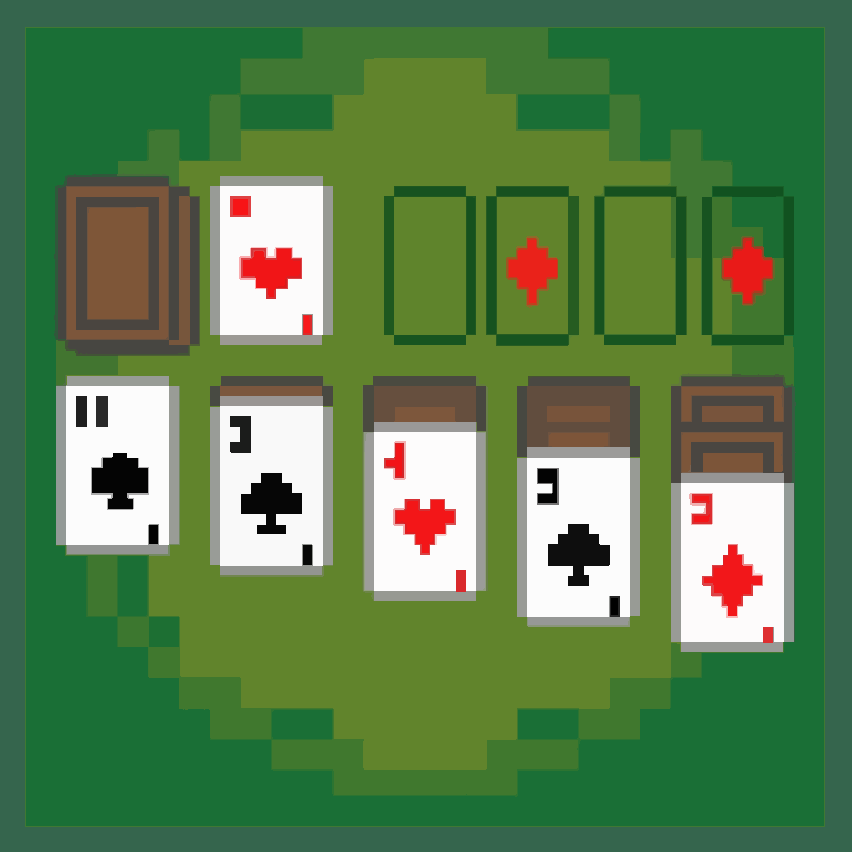
Canfield Solitaire packs a 12 card reserve, four tableau columns, and foundations that start on whatever rank the deal hands you. It carries the name of a casino owner said to have sold it to gamblers as a losing bet, and its 3% win rate makes the story easy to believe. Play it free here, no download.
How to Play Canfield Solitaire
Game info
- Decks: 1 (52 cards)
- Difficulty: Hard
- Game time: Medium
- Win rate: ~3%
- Type: Skill/Luck
Objective
Transfer all 52 cards to the four foundation piles.
The game
Foundations
- 4 piles that build up by suit
- Starting rank is determined by the first card dealt - all foundations begin at this rank
- Wrapping allowed (King continues to Ace)
Reserve
- 12 cards stacked with only the top playable
- Automatically fills empty tableau columns
Tableau
- 4 columns
- Build down in alternating colors, wrapping allowed
- Move the top card alone, or the whole column as one unit
- Empty columns fill from reserve (or any card when reserve is empty)
Stock & Waste
- Draw 1 or 3 cards depending on variant
- Unlimited passes through the deck
Variants
- Turn 1: Draw one card at a time (easier)
- Turn 3: Draw three, play only the top (harder)
Tips and Strategy
- The reserve is the game. A dozen cards sit there with only the top one available, so every plan should be measured by whether it drains the reserve.
- Do not clear a tableau column casually. Empty columns refill from the reserve automatically, which is usually what you want, but it also means you cannot choose what lands there.
- Remember that foundations wrap past King to Ace. A foundation starting at 8 runs 8, 9, 10, J, Q, K, A, 2 and so on, so a low card is not useless just because the pile started high.
- Cycle the stock with a purpose rather than hunting one card. Unlimited passes mean the stock is a resource you can revisit, but only the sequence of what you play changes what surfaces.
- Accept the loss rate. At around 3%, the correct measure of a good Canfield session is how far down the reserve you got, not whether you won.
About Canfield Solitaire
The game is named for Richard A. Canfield, who ran a fashionable casino in Saratoga Springs, New York in the 1890s. The story goes that he sold players a deck for $50 and paid $5 for every card they placed on a foundation, so a completed game returned $500 and almost nobody managed it. Historians treat the account with caution, and some argue the game he actually dealt was Klondike, but the name has stuck to this one.
The reserve is the point
Most solitaire games make the tableau the battlefield. Canfield makes it a corridor. A dozen cards are stacked in the reserve with only the top one reachable, and four short tableau columns are all the space you get to manoeuvre them out. Everything else in the design, the wrapping foundations, the variable starting rank, the unlimited stock passes, exists to give you just enough rope.
Canfield in Britain
The same game is known as Demon in the United Kingdom, and confusingly the game Americans call Klondike is sometimes called Canfield there. If you learned this game under another name, the reserve pile is how you can tell you are in the right place.
Frequently Asked Questions
Why is Canfield Solitaire so hard?
It was designed to be. The reserve releases only its top card, the tableau is just four columns wide, and the foundations start on an arbitrary rank. Around 3% of deals are won.
How do the foundations work in Canfield?
The first card dealt sets the starting rank for all four foundations. They build up by suit from that rank and wrap around, so a foundation starting at 9 continues through King to Ace and on up to 8.
Is Canfield the same as Demon Solitaire?
Yes. Demon is the traditional British name for the same game. To add to the confusion, some British sources use Canfield for the game Americans call Klondike, so the reserve pile is the reliable way to identify it.
What is the difference between Canfield and Klondike?
Canfield has a 12 card reserve, only four tableau columns, foundations that start on a random rank and wrap, and empty columns that refill from the reserve. Klondike has seven columns, foundations that always start at Ace, and no reserve.
Play More Solitaire
Canfield is a game you play for the progress rather than the win. At around 3% it is close to unbeatable, so the honest measure of a session is how far down the reserve you got before the board closed up.
When you want a fairer fight, these four are the closest stops:
- Klondike is the friendlier cousin: seven columns instead of four, foundations that always start at Ace, and no reserve pile breathing down your neck.
- Gold Mine shares the feeling of working from almost nothing. The tableau starts empty and you build it out of the stock, three cards at a time, in one pass.
- Bear River borrows Canfield's variable foundation rank and wrapping, then puts it in a completely different shape: eighteen piles capped at three cards each, with three holes to manoeuvre through.
- Penguin takes the same two ideas somewhere kinder. Its opening card sets the foundation rank just as Canfield's does, and its runs wrap the same way, but seven free cells and a face-up tableau push the win rate to around 90%.