Pyramid Solitaire
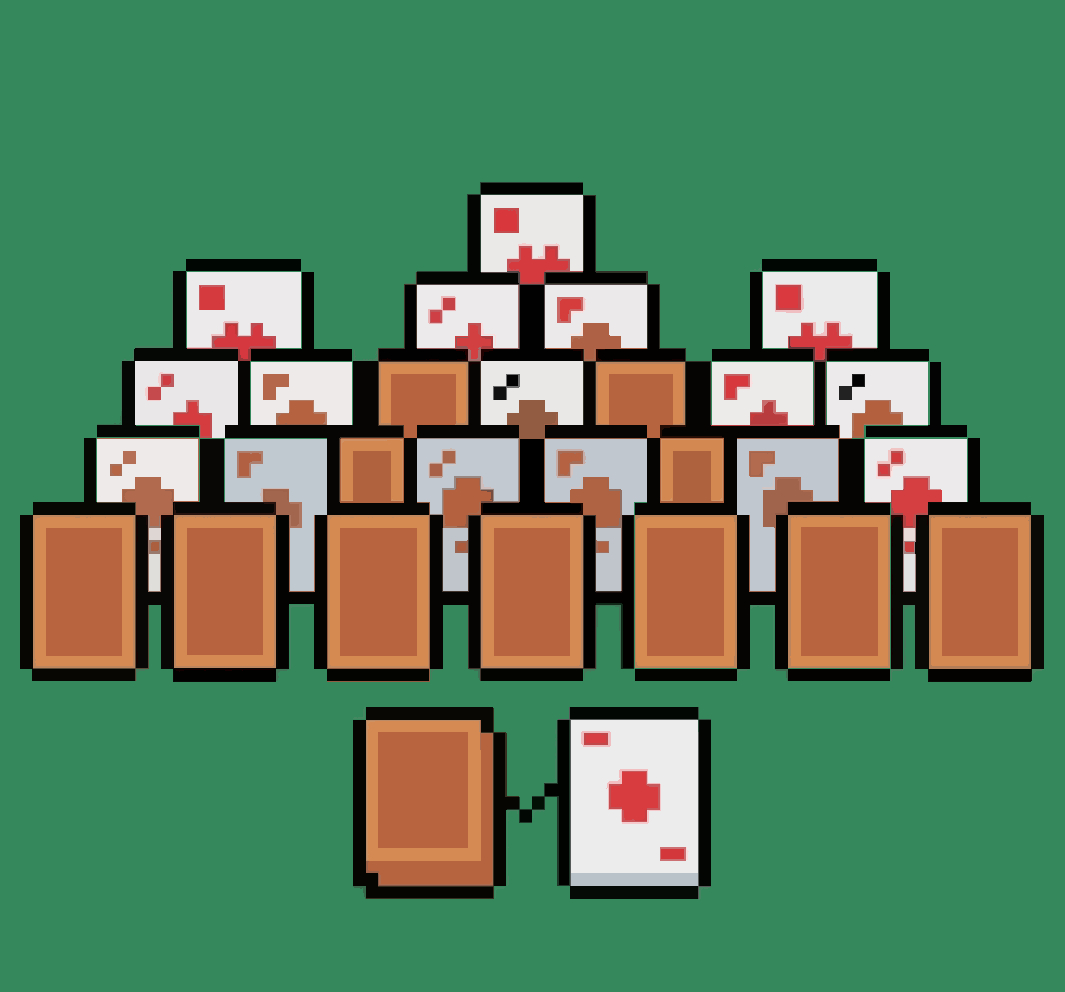
Pyramid Solitaire stacks 28 cards into a seven row pyramid and asks you to clear the whole deck in pairs that add up to 13, pyramid, stock and waste alike. Aces count 1, Jacks 11, Queens 12, and Kings clear on their own. Free here, no sign-up needed. The rules take ten seconds to learn, which is how the game keeps catching people out.
How to Play Pyramid Solitaire
Game info
- Decks: 1 (52 cards)
- Difficulty: Medium
- Game time: Medium
- Win rate: ~15%
- Type: Luck
Objective
Remove all 52 cards by pairing them off in twos that total 13. The pyramid, the stock and the waste all have to clear.
Card values
- Ace = 1, number cards = face value
- Jack = 11, Queen = 12, King = 13
- Kings remove themselves (already equal 13)
The game
The Pyramid
- 28 cards form 7 rows in a pyramid shape
- Cards become playable when nothing overlaps them
- Pair any two exposed cards totaling 13
Stock & Waste
- 24 cards remain in stock
- Flip cards one at a time to waste
- Pair waste top with pyramid cards or with stock top
- Three passes through the deck (the deal plus two redeals)
Valid pairs
A+Q, 2+J, 3+10, 4+9, 5+8, 6+7. Kings click alone. Suits don't matter.
Tips and Strategy
- Take Kings the instant they are exposed. They pair with nothing and cost you nothing, so a King left sitting in the pyramid is pure blockage.
- Clear the pyramid evenly across its width. Stripping one side opens a narrow channel and leaves the far corner sealed behind cards you can no longer reach.
- Before you pair two pyramid cards, check whether one of them matches the waste pile instead. Spending a stock card to save a pyramid card is almost always the better trade.
- Count your Kings and Queens as you go. If two Queens are still buried deep in the pyramid and both Aces have gone to the waste, the deal is already over and you can restart rather than grind it out.
- Do not burn through the stock on the first pass. You get three trips through it, and each later one is worth much more once you have opened the pyramid up.
About Pyramid Solitaire
Pyramid belongs to the adding family of solitaire games, where cards combine by value rather than stacking into sequences. That makes it feel closer to a puzzle than to Klondike or Spider, and it is one of the most searched solitaire variants precisely because it looks so approachable on screen.
Why 13?
Thirteen is the number of ranks in a suit, so pairing to 13 uses each rank exactly once against its complement: Ace with Queen, 2 with Jack, 3 with 10, 4 with 9, 5 with 8, 6 with 7. Kings are already 13 on their own, so they leave alone. Suits and colours are irrelevant throughout, and that is the entire arithmetic of the game.
How hard is Pyramid Solitaire?
Around 15% of deals end in a win, which puts Pyramid among the harder common variants despite its simple rules. The difficulty is structural: the pyramid covers each card with two others, so a single card stranded near the top row can lock out an entire branch. Good play improves your rate meaningfully, but the deal still holds a large vote.
Frequently Asked Questions
How do you play Pyramid Solitaire?
Remove pairs of exposed cards whose values add up to 13. Aces are 1, Jacks 11, Queens 12 and Kings 13, so Kings are removed by themselves. A card is exposed once no other card overlaps it, and you can pair pyramid cards with each other or with the top of the waste pile.
What pairs add up to 13 in Pyramid?
Ace and Queen, 2 and Jack, 3 and 10, 4 and 9, 5 and 8, and 6 and 7. Kings are worth 13 on their own and clear without a partner. Suits never matter.
What percentage of Pyramid Solitaire games can be won?
Roughly 15% with good play. The overlapping layout means some deals seal cards away no matter how you approach them, so restarting a clearly dead board is a legitimate tactic rather than giving up.
How many passes through the stock do you get?
Three. The 24 cards not used in the pyramid go to the stock, and after the first pass you may recycle it twice more, which makes the timing of your early passes the most important decision in the game.
Play More Solitaire
Pyramid is the rare solitaire game you can explain in one sentence and still lose fifteen times running. Pairing to 13 takes no learning at all, but the overlapping layout means a single card left in the wrong place can seal off a whole branch, and knowing which pair to take first is the entire skill.
If you like clearing a layout rather than building one, try these four:
- Tri Peaks uses a similar overlapping shape but clears cards in chains one rank up or down instead of in pairs. It forgives much more, with around 90% of deals winnable, and a good chain collapses a whole peak at once.
- Six Peaks is the same idea doubled: two decks, six peaks and much longer chains, for when you want the session to last.
- Golf strips the layout flat. Seven columns, only the bottom card of each in play, and a single waste pile to chain onto. Games take a couple of minutes.
- Elevator combines both halves: Golf's chaining rule applied to a pyramid layout, so chains and overlapping cards work on you at the same time.