FreeCell Solitaire
FreeCell Solitaire is free to play online with nothing to install: all 52 cards face up across eight columns, four cells to shuffle them through, and almost every deal winnable. FreeCell hides nothing and deals nothing after the start, so if you lose a game the shuffle was rarely the reason.
How to Play FreeCell Solitaire
Game info
- Decks: 1 (52 cards)
- Difficulty: Easy
- Game time: Medium
- Win rate: 99%+
- Type: Skill
Objective
Transfer all 52 cards to the four foundation piles.
The game
Foundations
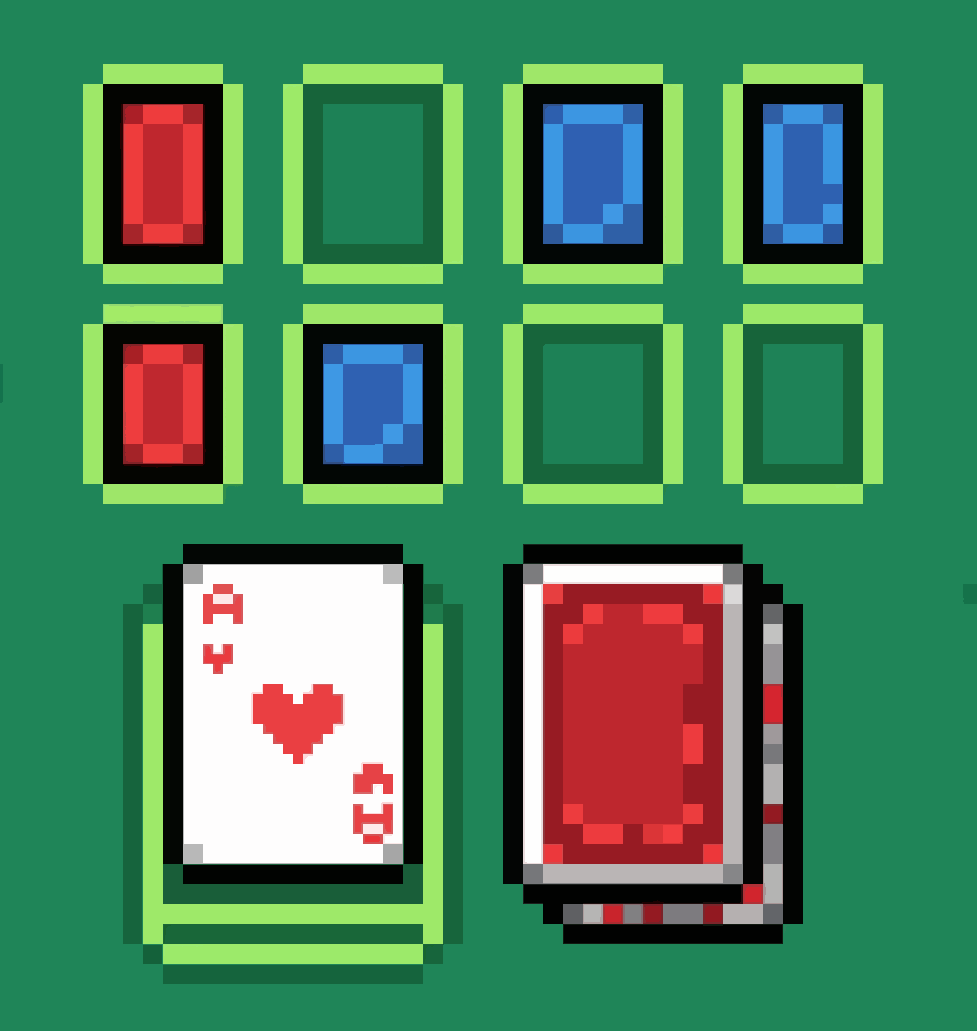
- 4 piles in the top right
- Build each suit up from Ace through King
Free Cells
- 4 cells in the top left
- Each holds one card temporarily
- Use them to maneuver cards between tableau columns
Tableau
- 8 columns with all cards face-up
- Build down in alternating colors
- Move multiple cards if enough free cells and empty columns exist
- Any card can fill an empty column
Power moves
Technically only one card moves at a time, but the game shortcuts this. Available moves = (empty cells + 1) multiplied by 2 for each empty column.
Tips and Strategy
- Read the whole board before your first move. Every card is visible, so the opening move you make blind is the one you will regret ten moves later.
- Free cells are working space, not storage. A card parked in a cell with no plan to get it out costs you a move multiplier for the rest of the game.
- An empty column is worth more than an empty cell. Cells double your movable run size, but a column both doubles it and gives you somewhere to unload a King.
- Dig for Aces and Twos first, but do not send every low card to the foundation on sight. A 3 left in the tableau can still catch a 2, and premature foundation play is the classic FreeCell trap.
- Watch for Kings sitting on top of their own suit's low cards. That column has to be unpacked eventually, and it gets more expensive the longer you leave it.
About FreeCell Solitaire
FreeCell was designed in its modern form by Paul Alfille in 1978 on the PLATO computer system at the University of Illinois, which makes it one of the very few classic solitaire games that was born on a screen rather than adapted to one. Its rules depend on being able to move runs automatically, which is tedious with physical cards and effortless with a computer.
The 32,000 deals
Microsoft bundled FreeCell with Windows from 1995, shipping 32,000 numbered deals. Players organised to solve every one of them, and the effort turned up a single deal that cannot be won: number 11,982. That one unsolvable hand out of 32,000 is the clearest statement of what makes FreeCell different from the rest of the family. When you lose, the loss is yours.
The power move rule
Strictly speaking you can only ever move one card at a time in FreeCell. The reason you can drag a run of five is that the game performs the single card moves for you, using the free cells and empty columns as temporary space. That is why the number of cards you can shift equals one plus your open cells, doubled for each empty column. Keeping cells and columns open is not tidiness, it is literally how far you can reach.
Frequently Asked Questions
Is every FreeCell game winnable?
Almost. Of the 32,000 numbered deals shipped with Microsoft FreeCell, exactly one, deal 11,982, has been proven unsolvable. On random deals the solvable rate is above 99%, so a loss is nearly always a solvable game played wrong.
How many cards can I move at once in FreeCell?
One plus the number of empty free cells, doubled for every empty column. With four open cells and no empty column you can move five cards; with four cells and one empty column you can move ten.
Should I fill the free cells?
Only with a plan to empty them again. Each occupied cell reduces how many cards you can move in one go, so cells filled early with no exit route are the most common cause of a stuck FreeCell board.
What card can go into an empty column in FreeCell?
Any card, unlike Klondike where empty columns take only Kings. That flexibility is what makes empty columns the single most valuable resource in the game.
Is FreeCell harder than Klondike?
It is harder to play well and much easier to win. Klondike hides cards and hands you deals that cannot be beaten, while FreeCell shows you everything and expects you to find the line. Skill decides FreeCell, luck decides a large part of Klondike.
Play More Solitaire
FreeCell is the game to play when you want the outcome to be your fault. Nothing is hidden, nothing is dealt after the start, and almost every deal has a solution waiting in it. A loss is a puzzle you have not cracked yet rather than a shuffle that beat you.
If that appeals, these four ask the same question with different resources:
- Eight Off doubles the cells to eight and then takes the freedom back by requiring same-suit building and Kings only in empty columns. Similar difficulty, reached by a completely different route.
- Penguin gives you seven cells and runs that continue past Ace onto a King, so a descending sequence never dead-ends. The first card dealt sets the foundation rank and sets the shape of what follows.
- Baker's Dozen removes the cells altogether. Thirteen face-up columns, Kings sunk to the bottom, and empty columns that can never be refilled, yet around 85% of deals still come out with careful play.
- Klondike is the opposite proposition: hidden cards, a stock to cycle, and deals that are lost before you start. Worth a game when you want the shuffle to carry some of the weight.